An Onitsha Trading Elder Reveals the Forgotten 'Two-Purse Method' That Helps Nigerian Breadwinners Who Have Given Out Everything Finally Build Something Quietly for Themselves — Without a Single Family Confrontation

You know that moment at the end of the month?
The one where you open your banking app — not to check how much you have, but to confirm how little is left.
Your salary came in. You know it did. You watched the notification light up your phone on the first of the month like it always does.
But by the time the calls came — your mother, your younger brother, your sister and her emergency — the money that was supposed to be yours had already started moving.
You'll handle it, they say. You always do.
So you handle it. Again. And again. And again.
And somewhere between the tenth year of being the one who handles it and tonight, something happened that nobody warned you about.
You started dreading the first of the month instead of celebrating it.
You go to family events and smile. Your colleagues think you are doing well. Your mother tells her church friends you are a good son. Your siblings post birthday tributes about how blessed they are to have a brother like you.
And yet.
By the 19th or 20th of every single month, you are standing in the exact same financial position as someone who earns half your salary.
How? You work hard. You are not wasteful. You do not drink your income away.
You just give. Quietly. Consistently. Without stopping.
You tried saying no once. The call lasted four minutes. By the end of it you felt like a stranger to your own blood. You caved. You sent the money. You swore you would never try that again.
You tried giving less without explaining. Within six weeks they noticed. Someone called your wife. Your wife asked you what was happening. That experiment ended quietly and nothing changed.
You tried honest conversation — showing them the actual numbers. Your uncle looked at the screen for a moment and said: “But you work at that company.” He had already decided what your life looked like. Your numbers were irrelevant to the story he had built in his head.
You tried saving first. The emergencies arrived before your third month. Every time.
You are not a bad man. You are not ungrateful. You are not selfish.
You are simply a man who has been operating without a second purse.
And I am about to tell you what that means — and why understanding it changes everything.
Drop everything you are doing now and listen to every word I am about to say.
Because I am about to share with you a simple wealth protection method that changed everything for me — and it came from the last place I expected.
Our grandfathers knew something we have forgotten.
In the trading families of Onitsha, Aba, and Ibadan — the ones that built wealth lasting three generations — the men who survived did not do so by giving less. They survived by building a second financial structure their family never saw. It ran quietly, invisibly, in parallel with the family account. The family saw one purse and spent from it freely. A second purse was growing in a place only the man knew about.
It was never written down. It was passed from father to son, from uncle to nephew, in conversations that happened at the back of market stalls and under mango trees. Somewhere between our parents' generation and ours, the secret got buried in the noise of bank alerts and the pressure to be the one who handles everything.
My name is Nnamdi Obi.
First thing you should know about me: I am NOT a financial advisor. I am not a certified wealth coach or a banker.
I am just a man from Surulere, Lagos — 36 years old, married, two children — who gave out everything for eleven years, sat down one rainy night and discovered he had ₦52,000 in savings after a decade of working, and decided something had to change.

The Night That Broke Something Open in Me
It started the way it starts for most of us.
I got my first real job in 2015. By the time I was promoted that year, I was earning more than anyone in my immediate family had earned at my age. My mother told her pastor. My father — God rest him — could not stop smiling.
Then the calls started. Not aggressively. Slowly, like water finding its way through a wall.
First, my younger brother Ifeanyi needed his WAEC registration. Of course. I am the big brother. I paid without thinking. Then my sister Adaeze's market stall needed startup capital — “just a loan,” she said. She still calls it a loan. Then school fees for a cousin. Then a family burial contribution. Then my mother's church building fund. Then hospital bills for an uncle with no insurance. Then rent advance for a cousin who had just moved to Lagos.
You work at that company. You can afford it. God will repay you.
I told myself it was temporary. Once Ifeanyi was settled. Once Adaeze's shop was stable. Once my mother's situation was sorted. There was always an “once.” The once never arrived. Because as soon as one thing settled, something else needed attention.
The Slow Sickness Nobody Names
The emotional cost crept up like a slow sickness. My wife Chioma started noticing changes in me — not the money, but me. The way I flinched when my phone lit up on a Wednesday. The way I went quiet every time the end of the month approached. The way I started to hate Sundays, because Sunday meant Monday was coming.
I stopped sleeping well. I would wake up at 3am with a low, dull dread in my chest. A financial anxiety that never fully switched off. I learned to function on top of it. I assumed it was just what adult life felt like.
Then something else arrived that I am still ashamed to admit. Resentment. Not the loud, burning kind — the quiet kind. The kind that sits in your chest at Christmas dinner while your brother is telling a joke, and you remember you helped pay for the car he drove to that dinner.
I did not want to feel it. But I did. And feeling it made me feel guilty. And the guilt made me give more. And the giving made the resentment worse.
It was a cycle I could not name and could not break.
The Number I Could Not Unsee
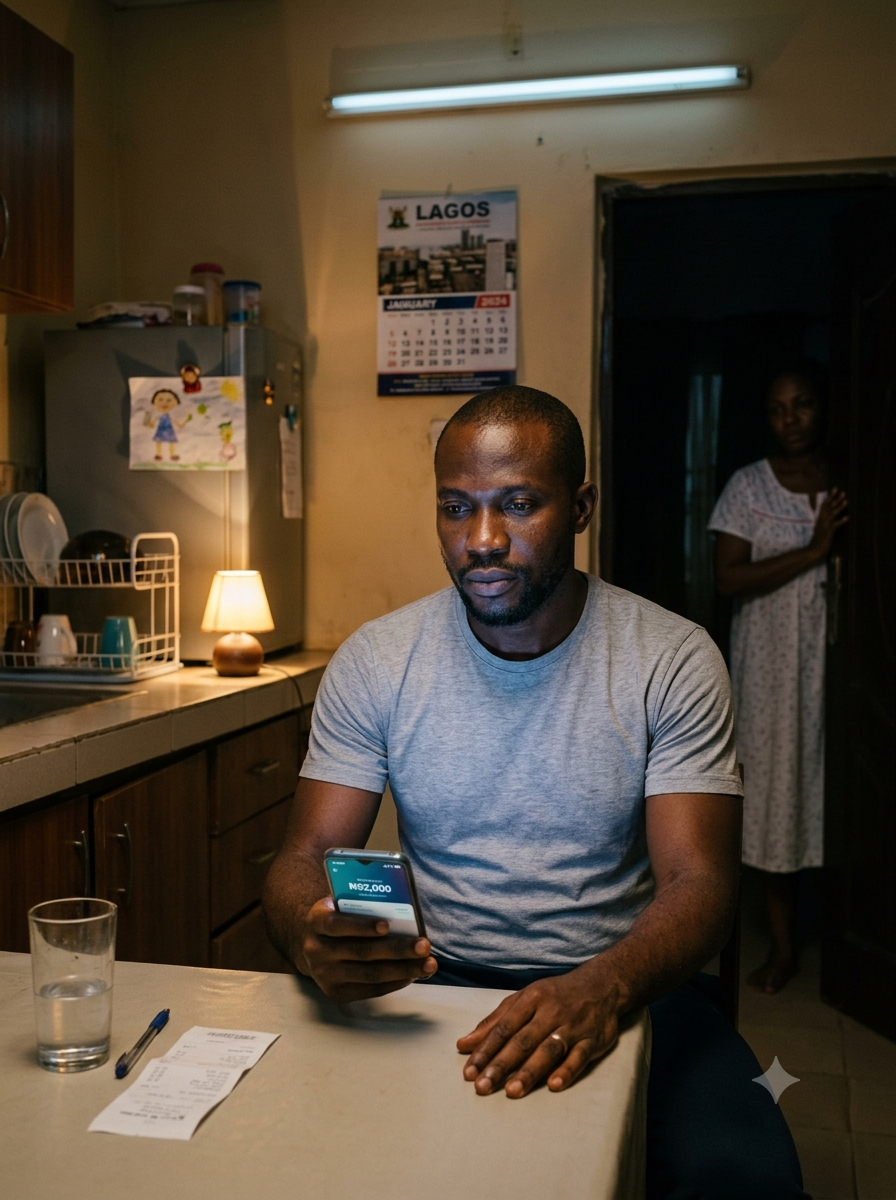
The breaking point came on a Wednesday night in January 2024. Chioma and I had just put the children to bed. I sat at the kitchen table trying to calculate how to cover school fees due at the end of the month. I opened my banking app.
My balance was ₦52,000. My salary had arrived four days earlier.
I sat there completely still. Not crying. Not angry. Just still. Eleven years of working. This was the number that remained.
Chioma found me in the kitchen at midnight. She sat beside me without saying anything for a long time. Then, quietly: “Nnamdi. You have built everyone. When are you going to build us?”
That sentence moved through me like something cold and true. She was not angry. She was simply right. And the fact that she had been sitting with that truth without burdening me with it made it hit harder than any argument would have.
Lagos, January 2024. ₦52,000 after eleven years.
Everything I Tried That Failed
By that night in January, I had already tried everything I could think of.
I tried saying no directly. Once. My mother did not eat for two days. My brother told my aunt I had changed since the promotion. The family mobilised quietly. By day four I had sent the money anyway — just to make the pressure stop. I never tried that again.
I tried giving less without explaining. Within two months they noticed. Calls increased in frequency. Someone phoned my wife. The assumption was that something had gone wrong at work. It created problems I had not anticipated and solved absolutely nothing.
I tried honesty. Opened a spreadsheet, showed them the actual numbers — what I earned, what the family transfers cost me each month. My uncle looked at the screen and said: “But Nnamdi, you work at that company. You are doing well.” He had already decided what my reality was. My numbers were irrelevant to the story he had built in his mind.
I tried saving first — locking money in a savings account the morning my salary arrived. Month one, my sister's shop flooded. Month two, my mother needed urgent hospital tests. Month three, Ifeanyi was between jobs. The emergencies never took a month off. My savings never reached any meaningful amount.
I set a fixed monthly family allowance. Announced it clearly. For two months they accepted it. Then mid-month requests started arriving. “Just this once, it's different.” The fixed amount became a negotiating floor, not a ceiling. It was meaningless by month four.
After five failed attempts and eleven years of working, I had arrived at what felt like the only conclusion: there was no solution for men like me. Men born into families where our success is the family's financial infrastructure. You give until you collapse, or you destroy your relationships trying to stop.
Under a Mango Tree in Onitsha
Uncle Chukwudi, 72. Cloth trader. Onitsha Main Market, retired. He explained it like it was obvious.
Then I went to a family burial in Onitsha. January 2024. A great-uncle's wife had passed. I went out of duty more than grief.
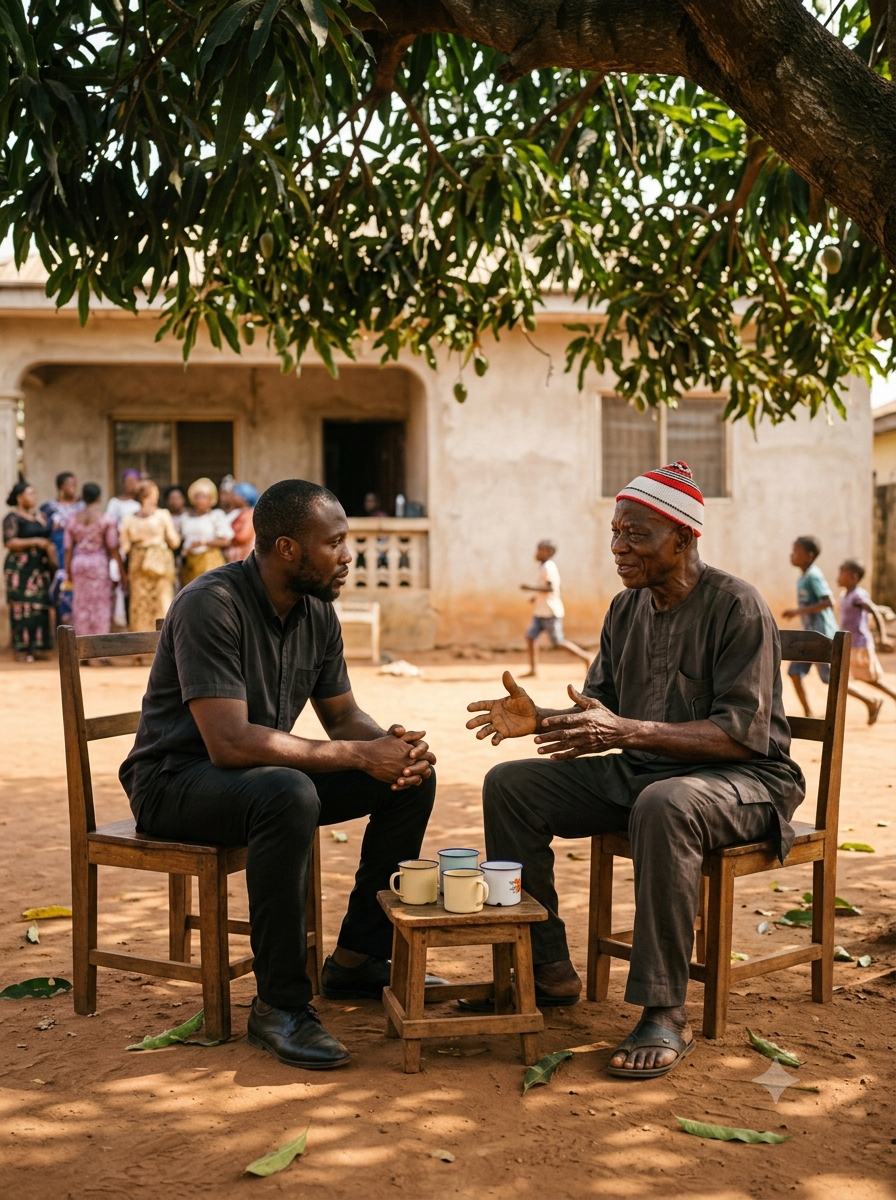
On the second afternoon, in the late heat when the younger men were inside watching football, I found myself sitting outside under a mango tree with my father's older brother — Uncle Chukwudi.
He is about seventy-two now. He spent his working years as a cloth trader in Onitsha's main market. The kind of man who never drove a flashy car but quietly bought land in four different places before he was fifty. The family assumed he was lucky. I had never sat with him long enough to ask how.
I do not know what made me tell him. Perhaps the ₦52,000 was still sitting in my chest. Perhaps I was just tired of carrying it alone.
I told him — not in full detail, but honestly — that I felt like I was working for everyone except myself. That I could not say no. That I could not save. That after eleven years, I had almost nothing to show for it personally.
He listened without interrupting. When I finished, he was quiet for almost a minute. Then he smiled — not unkindly — and said in Igbo: “Your father never told you about the second purse.”
“Every trader in this market,” he said, gesturing toward the road, “knows that you cannot run your family account and your growth account from the same pocket. The moment your family can see your money, it is already spent. Not because they are bad people. Because that is how it works. You are one person. The need is many people. One pocket cannot win that fight.”
He explained it the way a man explains something that has always been obvious to him. In his trading years, he kept two things: a visible purse — money the family knew about, for family needs. And a second purse — invisible, growing quietly, in a place no family member knew to ask about. Not hidden from God, he said. Not hidden from his wife. Hidden from the people who would empty it.
“Your grandfather did the same,” he said. “His father before him. The market women of Onitsha and Ibadan understood this before any of us were born. It was never selfish. It was how you stay capable of giving at all. A man with nothing cannot help anyone.”
I sat under that mango tree and felt something shift in my chest. It was so simple. How had I never thought of this?
“But the emergencies,” I said. “Every time I try to save, one arrives.”
“The emergency will always come,” he said. “The question is whether the second purse has already moved before the emergency arrives. You have been trying to save what remains. You must move what is first.”
The First 12 Days
I drove back to Lagos with a different mind. I will be honest: I did not believe it would work at first. I had tried saving first. The emergencies always came.
But this was different. Uncle Chukwudi was not talking about saving first the way I had tried it. He was talking about making the second purse invisible — structurally separate, on a different app, automated to move the morning my salary landed, before anyone called, before I could second-guess myself.
I set it up in one evening. A PiggyVest account with a name only I would understand. An automation that triggered at 7am on the first of each month. A starting amount small enough that its absence from my main account would attract no attention.
The first eleven days felt no different. The calls came. I handled them from my visible account. I kept waiting for something to reach into the second purse.
Nothing reached for it. Because nobody knew it was there.
On day twelve, I opened the second account.
There was ₦21,500 sitting there. Untouched. Two weeks old. Mine.
I sat in my car in the work car park and felt something crack open in my chest that had been sealed for years. It was there. It was mine. Nobody had asked for it because nobody knew it existed.
Day 12. Work car park. ₦21,500 — untouched, growing, mine.
I thought about the ₦4.3 million I had given to family over eleven years — a number I had only just calculated by going back through old bank statements. Then I thought about what that money would have become at 15% compound interest over a decade. The figure I arrived at made me put my phone face-down on the seat and just breathe.
But I did not look backward long. The second purse was open. I was going to fill it.
The Moment Chioma Noticed
Six weeks in, my wife said something that stopped me mid-sentence. We were in the living room on a Saturday morning. I was helping our son with his reading and actually laughing at something he said. Chioma was watching me from the kitchen doorway.
“Something is different about you,” she said. “What do you mean?” “You seem lighter. Like something heavy has moved off your shoulders. You were just laughing — really laughing. You have not done that on a Saturday in a long time.”
“You seem lighter. You have not laughed like that on a Saturday in a long time.”
She was right. The low-level dread that had lived in my chest every morning for years was quieter. Not gone. But quiet. I could breathe around it.
When I showed her the second account two months later, she started crying. Not because of the amount — it was not dramatic yet. But because it was there. Something existed that was just ours, growing without anyone pulling at it.
“Nnamdi,” she said, hands around her phone, staring at the screen, “this is the first time since we got married that I feel like we have something building. Just for us.”
Three Men Who Changed Their Story
I started quietly sharing the method with men I trusted.
Dele, 41, a civil engineer in Abuja. After eight months, he had saved ₦380,000 — more than he had accumulated continuously in twelve years of working. His family still calls. He still gives. But he gives from the visible pot, and the second pot keeps growing in a place nobody can reach.
Emeka, 38, Lekki. His words to me last month, unprompted, via WhatsApp: “Bro. I slept past 3am for the first time in years. I didn't even know the 3am thing was connected to money until it stopped.”
Biodun, in Peckham, London, was sending remittances home that left him with almost nothing each month. Six months into the method, he had enough saved to cover his own emergency for the first time. He texted me: “I finally have a Plan B that my family can't accidentally cancel.”
After months of watching this work — for men in Lagos, Abuja, London, Toronto, and Houston — I sat down and wrote everything out. The full system. The exact account setup. The specific Nigerian fintech options. The scripts that let you manage every family request without saying no directly. The compound interest tables. The audit tools. The emergency protocols.
I put everything inside one clear, straightforward guide.
Introducing…
Now Available
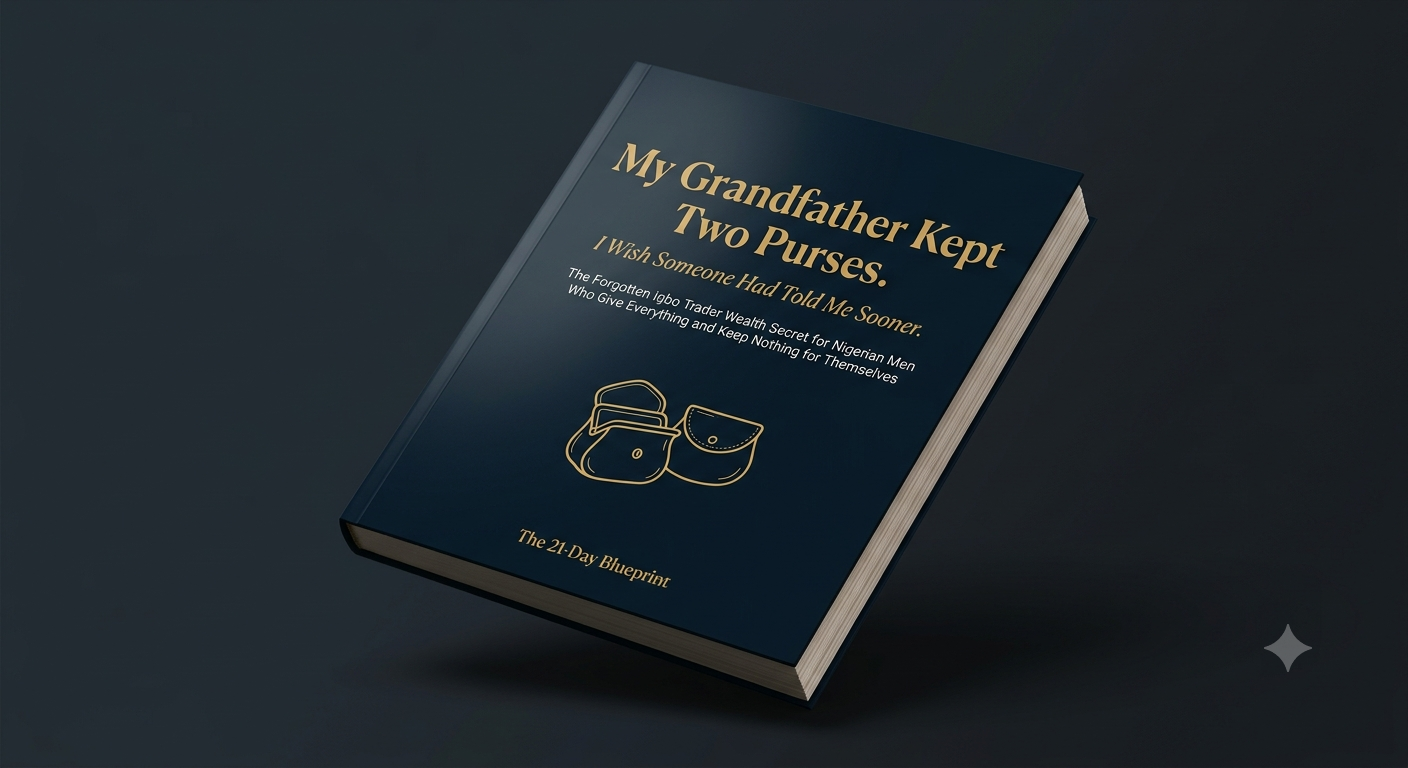
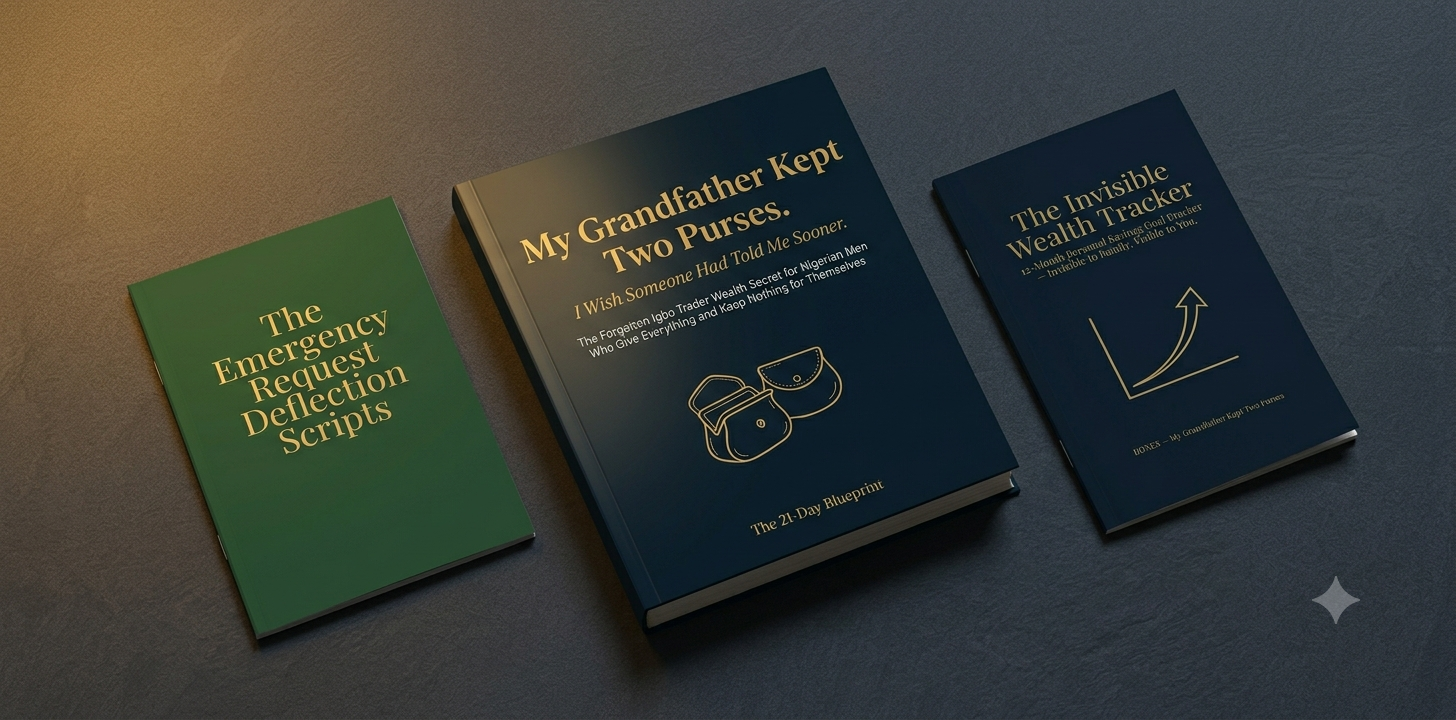
My Grandfather Kept Two Purses.
I Wish Someone Had Told Me Sooner.
The Forgotten Igbo Trader Wealth Secret for Nigerian Men Who Give Everything and Keep Nothing for Themselves
✶ 21-Day Step-by-Step Blueprint PDF ✶
Inside This Guide, You Will Discover:
- The Family Tax Audit Worksheet — the number that ends comfortable numbness. Starting on page 2, before any strategy begins, this 12-month forensic reconstruction template shows you the exact naira amount extracted from your earnings by family over the past year — then converts it to what that money would have become at 15% compound interest. Most men discover they have given away 30–60% of gross income. You cannot unsee this number. And seeing it is what finally makes change feel not just possible but necessary.Pages 2–5
- The Parallel Pot Setup Checklist — the exact architecture of your second financial identity. Which Nigerian fintech to use (PiggyVest, Kuda, Carbon), what starting amount attracts no attention, how to automate the transfer so money moves before any request arrives, and how to structure the account so it is invisible to anyone looking at your financial life.Pages 6–12
- The Five-Script Card — word-for-word responses for every family money request, without saying no. Five specific scripts that redirect, delay, and manage every common family request without direct refusal, without lying, and without damaging the relationship. Field-tested by men who could not afford a wrong word with their families.Pages 13–17
- The Wealth Milestone Calendar — a 12-month invisible personal savings goal tracker. Month-by-month targets calibrated to a Nigerian salary range, with the psychological anchor points that prevent you from dipping into the second purse during hard months.Pages 18–22
- The Provider Sustainability Index — honest data your family will never give you. A monthly self-assessment that tells you, in under ten minutes, whether your current giving pattern is financially sustainable or silently destroying your future.Pages 23–26
- The Relapse Recovery Protocol — for genuine emergencies that require you to dip in. Real life happens. This gives you the exact steps to recover momentum after an emergency withdrawal without losing months of progress.Pages 27–30
- The Compound Interest Visual Table — what ₦50,000 per month becomes over time. A single visual showing ₦50,000 saved monthly over 5, 10, and 15 years at 15% per annum. Most men keep this page on their phone as a permanent reminder of what they are building.Page 31
And the best part? You do not need to survive a single confrontation or damage a single relationship. It is the same method that worked for me — and has now quietly changed the financial picture for over 60+ men I have personally guided through it.
Real Men. Real Results.
Bros I don't know how to explain this. Eight months ago my account balance was genuinely embarrassing me. I've been using the Two-Purse system since March and right now I have ₦340,000 sitting in a place nobody in my family knows about. My mum still calls. I still answer. I still give. But that money is untouched and growing. The Parallel Pot Checklist is everything — follow it exactly and don't skip the automation step. That one step changed the whole game for me.
When I saw the price I was going to move on. Then I read the opening about the ₦4.3 million and I had to stop. I went into my bank statements going back seven years. When I saw my own total — and what it would have been at compound interest — I bought without hesitation. The Five-Script Card is worth ten times what this costs. I used Script 3 on my brother last Sunday. He said okay and that was the end of the conversation. No drama, no guilt trip, nothing.
I'm in London sending money home every month and it was leaving me with almost nothing. My family don't understand UK living costs — they convert my salary to naira and think I'm sitting on a fortune. This is the first thing I've found that actually understands my situation as a diaspora man. The Parallel Pot setup works perfectly with UK accounts and Wise. Six months in I've got £1,800 set aside that nobody back home knows exists. First real savings since 2019.
The Family Tax Audit on page 2 nearly broke me. I added everything up — hospital bills, sibling school fees, rent advances, ceremony contributions, emergency transfers — and the 12-month total was ₦1.2 million. Then I looked at the compound interest table on the same page. I closed my laptop and went for a walk. Came back and set up my Parallel Pot. That was four months ago. My second purse has ₦187,000. I am not stopping.
Nine years in Canada as the family breadwinner and I was burning out. My people back home think CAD and naira are the same scale. The Provider Sustainability Index showed me I was giving out 67% of my disposable income. Seeing that as a percentage with a category name hit differently than knowing it vaguely in my head. Six months later I'm at 41%. My second purse has CAD $2,200. Nobody in my family has any idea. And I sleep better than I have in years.
Share Your Experience
Just So You Know… Creating This Guide in a Clear, Usable Format Cost Me Over ₦187,000.
This was not a weekend side project. It took months of research, real-world testing with men in genuine situations, and several rounds of refinement before it was ready:
- ✶ Professional PDF design and typesetting by a Lagos creative studio — ₦45,000
- ✶ Financial research and compound interest modelling with a certified analyst — ₦38,000
- ✶ Consultation with a communications expert on the Five-Script Card language — ₦28,000
- ✶ Beta testing and live feedback sessions with 23 men across Lagos, Abuja, Port Harcourt, London, and Toronto — ₦52,000 in time and coordination
- ✶ Professional editing, proofreading, and user experience review — ₦24,000
I am not going to charge you ₦187,000 for this.
I am not going to charge you half — ₦93,500.
I am not even going to charge you ₦24,800, which would still be a fair price for everything inside.
You are getting the complete guide today for just:
Once 50 copies are sold at this launch price, the price returns to ₦24,800. No exceptions.
🔒 Secure checkout via Nestuge • Instant PDF Download • Works on any phone or computer
WAIT — I Have a FREE Gift For You…
If You Are Among the First 50 Buyers 🎁
Order the guide at the discounted price today and I will include two free bonuses that make the entire system even faster to implement:
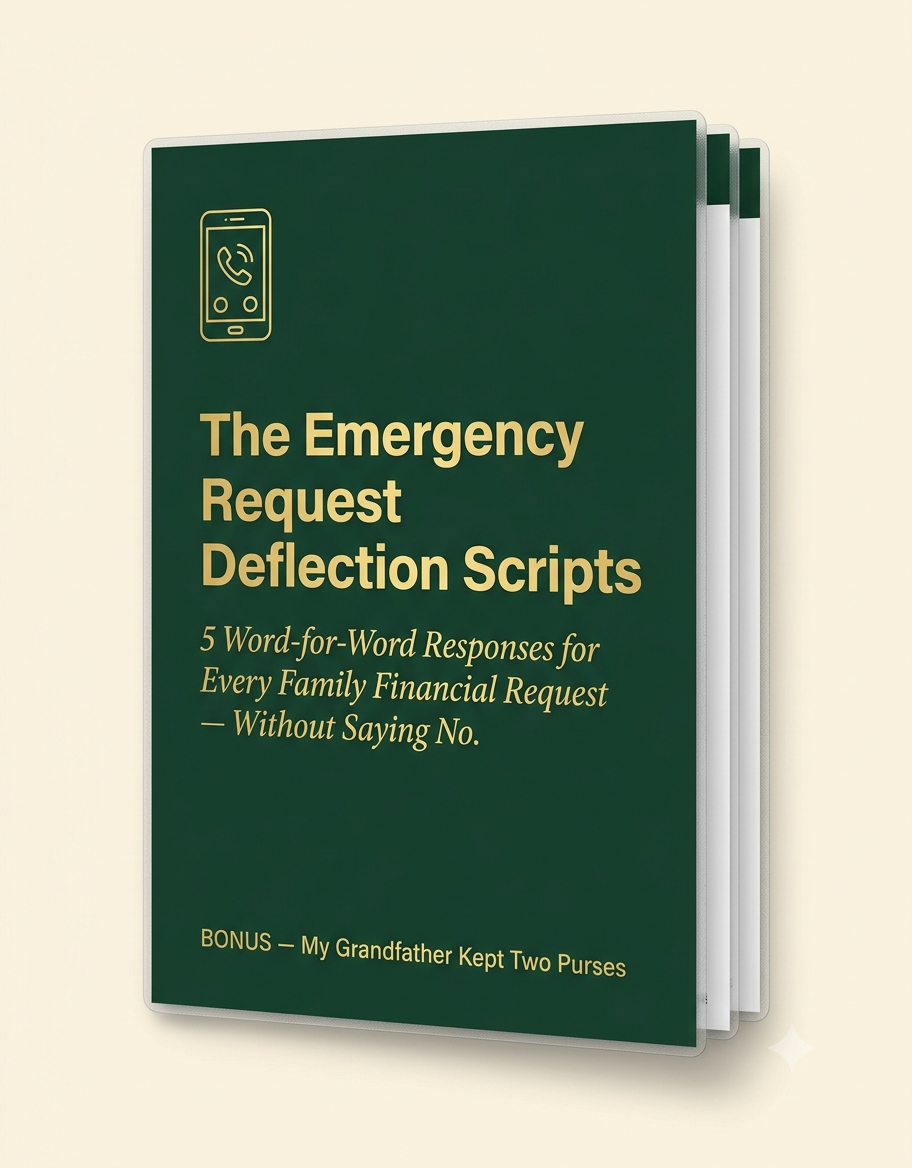
🎁 FREE BONUS #1: The Emergency Request Deflection Scripts
Valued at ₦7,500 — Yours FREESeven additional ready-made scripts for the toughest family money ambushes — surprise hospital situations, the “I'll pay you back” requests, and the calls that come on your worst financial days. Written in plain English and Nigerian Pidgin, field-tested by men who could not afford a wrong word with their families.

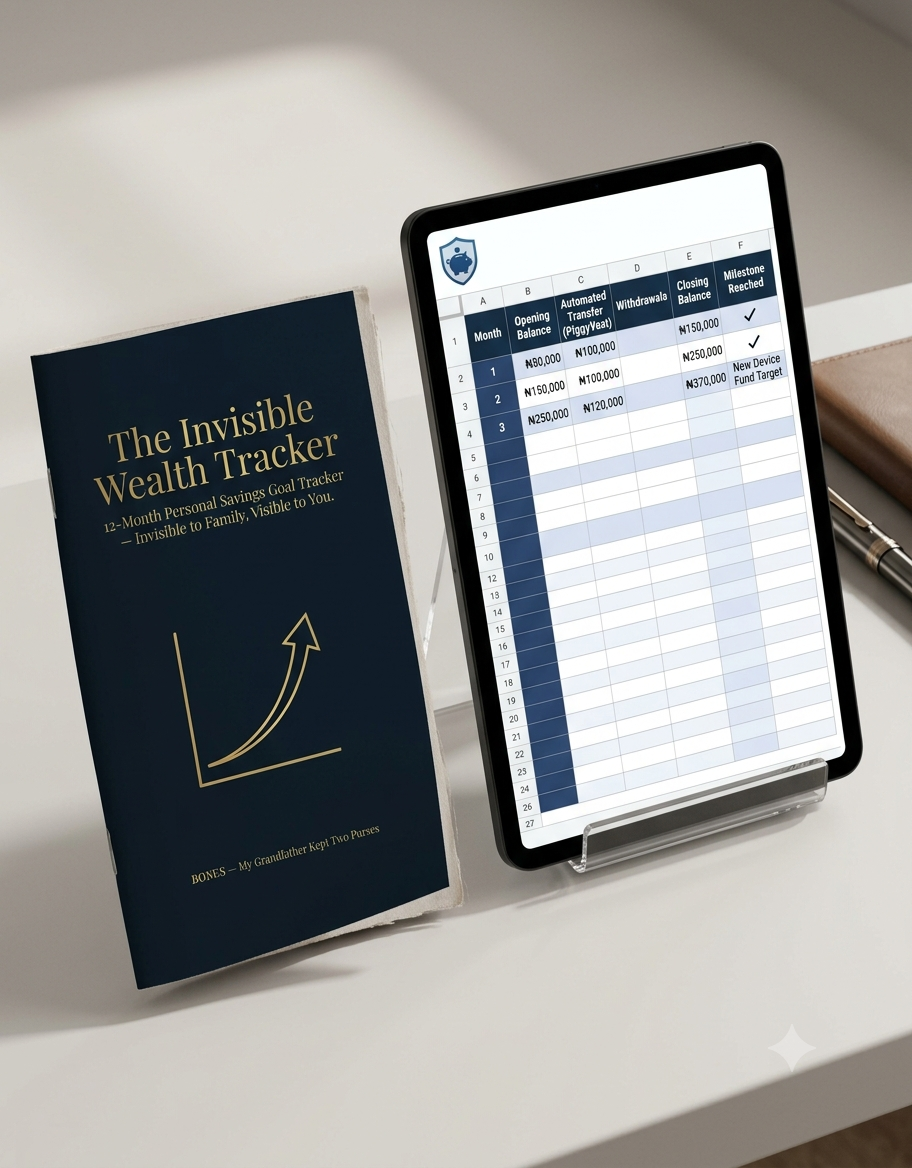
🎁 FREE BONUS #2: The Invisible Wealth Tracker Spreadsheet
Valued at ₦5,000 — Yours FREEA 12-month automated savings tracker pre-formatted for PiggyVest, Kuda, and Carbon users. Tracks your Parallel Pot growth, flags sustainability red zones, and calculates your projected compound growth automatically — so you always know what your second purse will be worth in 1, 3, and 5 years.

Men Are Moving. Fast.
While you are reading this, other men have already made their decision. Take a look at what has been coming in:
Two Purses — Buyer Confirmations
68 members
⚡ 38 of the first 50 discounted spots have already been claimed. Only 12 remain at ₦9,800.
Bear in mind — you are not the only person viewing this page right now.
🛡️ Still Feeling Unsure? I Completely Understand.
You have been let down before by things that promised to help with this problem. I know that. Which is why I am carrying all the risk here, not you.
Try the guide for a full 30 days. Do the Family Tax Audit on page 2. Set up your Parallel Pot using the checklist. Use the scripts when a request comes in.
If after 30 days of genuinely following the protocol you see no movement — no second purse started, no scripts working, no noticeable shift — send me a message and I will refund you in full. Every naira. No forms. No long wait. No questions asked.
The risk is mine. You either get the result, or you get your money back.
30-Day Full Money-Back Guarantee — No Questions Asked.
More From the Community
I go confess something. I nearly cried reading the opening section. Not because it was sad — because it was me. Word for word, that was my actual life on that screen. The part about waking up at 3am? Guy. I been doing that for three years and I thought it was job stress. It wasn't job stress. The second purse is five months old now. I sleep properly. My wife says I laugh again. Worth every single kobo.
As an Igbo man, the ancestral framing gave this credibility that no other finance guide has ever had for me. This is not Western advice repackaged. This is our own tradition — the way our grandfathers actually moved — given a modern structure I can use today. I trusted it immediately. By my second month, I had saved more than I had managed in the previous four years combined.
Bought this at midnight after reading the whole page in one sitting. By 2am I'd finished the Family Tax Audit. The eight-year total for London remittances almost made me physically ill. But it gave me a reason strong enough to finally change — not inspiration from a podcast, but a hard number I couldn't argue away. The Parallel Pot is four months old. It has never been touched. It is growing. That's all I needed to know this is real.
The Provider Sustainability Index was my wake-up call. I scored in the critical zone — 71% of disposable income going to family giving. Seeing it as a percentage with a category name was different from knowing it vaguely. This guide doesn't shame you for where you are — it shows you exactly where you are, then gives you the architecture to move. Four months later I'm at 41%. Still giving. Still a good son. Just not vanishing in the process.
I was skeptical about the Five-Script Card. Scripts don't work in Nigerian family dynamics — people feel when you're being scripted. I was completely wrong. These scripts work because they understand the psychology — they redirect without rejecting, delay without dismissing. I used Script 2 on my mother last month. She accepted it calmly. No drama. I nearly fell off my chair. I use the scripts differently now — more confidently — because I've seen them work.
This Is Your Moment of Decision.
You have read this far. The pain is real for you. You have recognised yourself somewhere in this story.
Right now, you have two paths in front of you:
❌ OPTION 1: Close This Page
Walk away. Go back to life as it is. Keep being the man who handles everything for everyone. Keep the 3am dread. Keep watching your salary move through your hands into everyone else's future while yours stays still.
Your family will call. You will answer. The month will end the same way it always does.
In twelve months, you will be in the same position. Perhaps further behind.
✅ OPTION 2: Get the Guide and Start Tonight
Complete the Family Tax Audit. See your real number — the one that changes how you think. Set up your Parallel Pot following the exact checklist. Watch money appear in a place nobody can reach. Money that is just yours.
In 21 days you will have a working personal wealth system. Your family will see what they have always seen. What they will not see is what you are quietly building for yourself.
In eight months, you will sleep past 3am.
Your mother will still call you a good son. Your family will still respect you. But for the first time — you will respect yourself.
The clock is ticking. Only 12 spots remain at ₦9,800.
🔒 Secure checkout via Nestuge • Instant PDF delivery • 30-Day Money-Back Guarantee
Questions? Contact: nnamdi@demo-ng.online